Overview
Cycling in Halifax is challenging for inexperienced cyclists: it's hard to get from one place to another when you're faced with barriers like steep hills, bad weather, or sharing the roads with terrifying fast cars. For the 50% of people living in Halifax who wished they could cycle more, barriers like these prevent them from even considering it. Meanwhile, Halifax Transit buses are equipped with bike racks that can take two cyclists anywhere they need to get. These racks can be used to get cyclists pasts the parts they don't feel comfortable cycling through, but nobody thinks to use them like this. Some people forget they exist entirely. The cyclists of Halifax have a problem, and Halifax Transit has a creative solution no one seems to use. This is where I come in. I am designing informational displays that will empower inexperienced cyclists to use Halifax Transit as a link between these gaps.
These informative displays are part of my Design Degree project for my Bachelor of Interdisciplinary Design at the Nova Scotia College of Art and Design. This project has been the result of a year long, self directed project based on the 17 goals for sustainable development established by United Nations. Professor Glen Hougan guided the research phase, professors Greg Dubeau and John DeWolf are guiding the development phase. Throughout the project I have consulted with professors May Chung and Rob Currie, and city planner Ben Hammer.
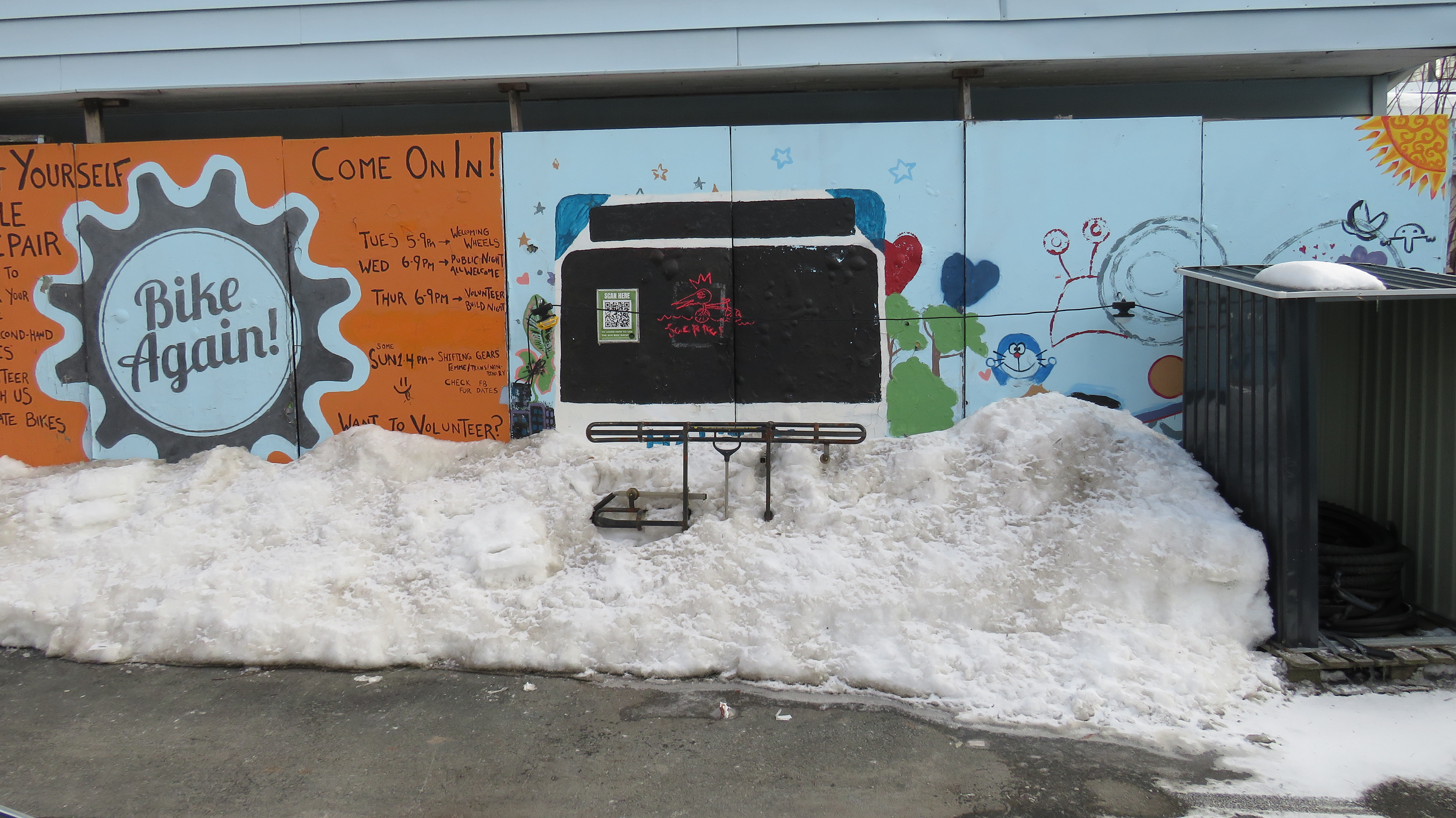
Thanks to the leadership of Ben Hammer and the Ecology Action Centre, a practice rack was installed at the Bike Again community bike repair shop here in the north end. Attached to the wall is a laminated flyer directing people to a tutorial video. When I stopped in to ask about it, volunteers noted that most people don't realize it's even there, and the practice rack goes unused.
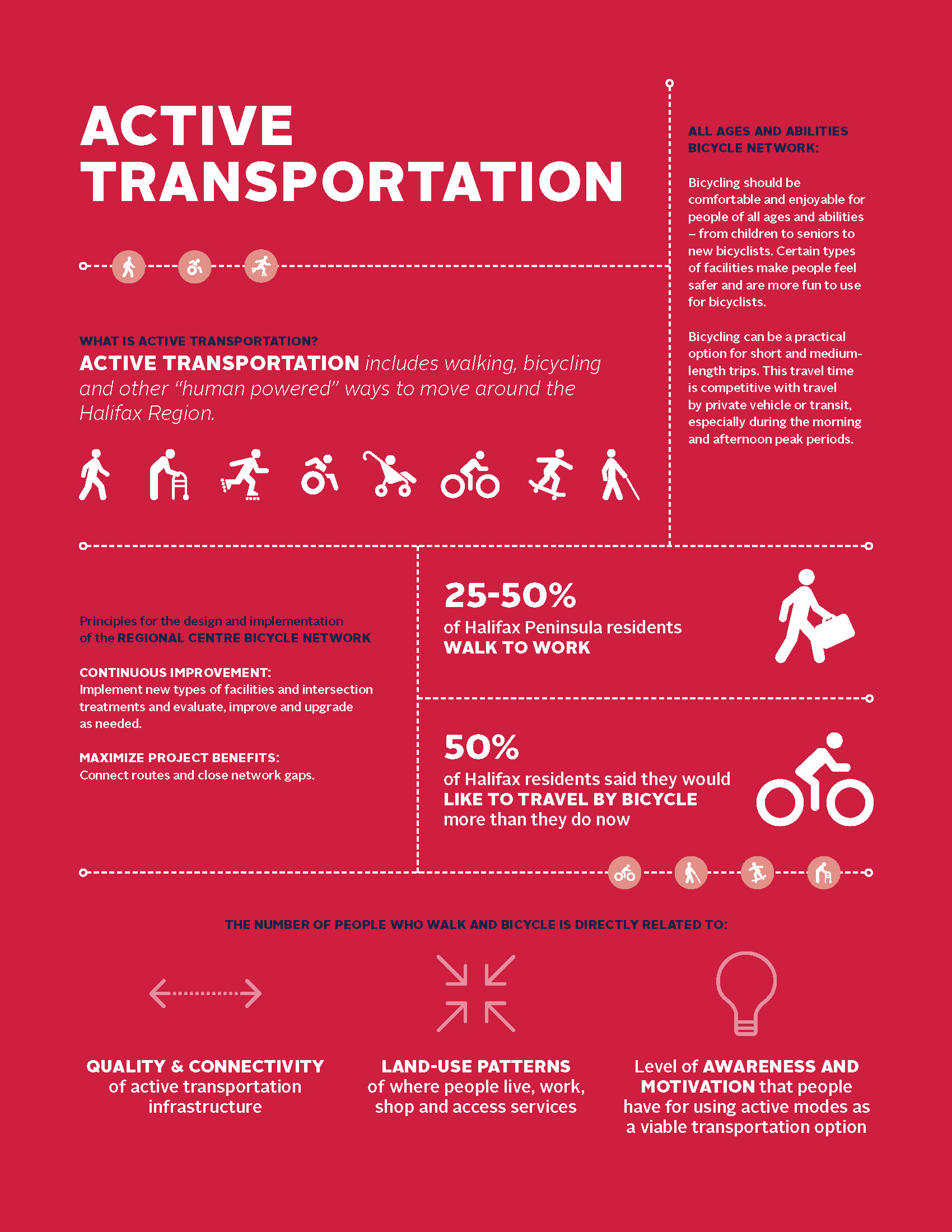
This is an exert from Halifax's Integrated Mobility Plan: a report of guidelines to help prioritize people over cars when planning urban development projects. According to this report, 50% of Halifax residents said they would like to travel by bicycle more than they do now. The entire report is available online and is linked at the bottom of this page.
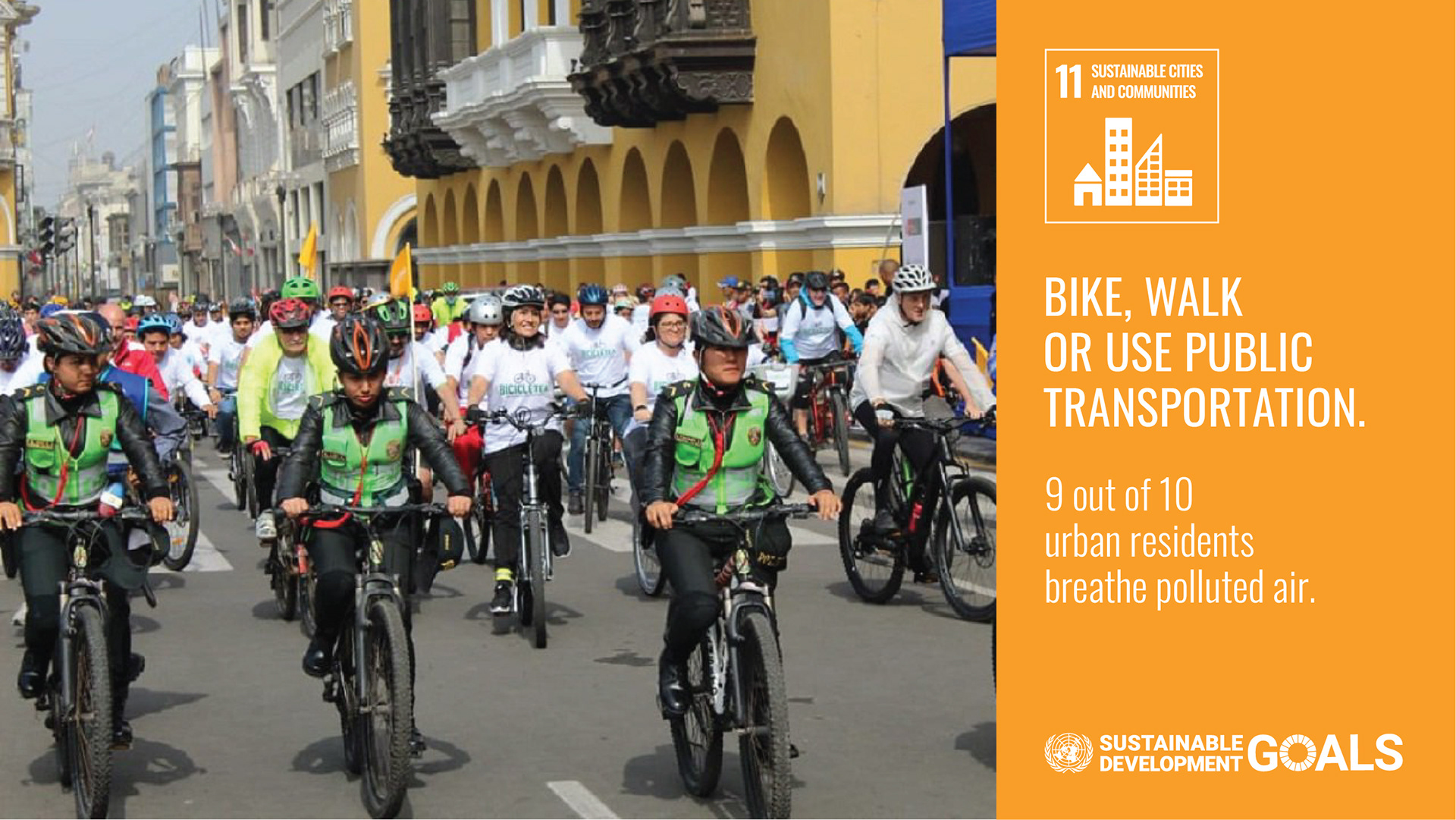
The United Nations established 17 goals for sustainable development to be met globally by 2030. Goal 11 is to make cities and human settlements inclusive, safe, resilient, and sustainable. Each goal has specific targets to help measure the goal's overall success. Target 11.2: By 2030, provide access to safe, affordable, accessible and sustainable transport systems for all, improving road safety, notably by expanding public transport, with special attention to the needs of those in vulnerable situations, women, children, persons with disabilities and older persons. My Link Informational Displays will bring attention to a safer and more accessible option for all cyclists. This graphic, developed by the United Nations as part of their media kit, highlights the importance of cycling, walking, or using public transportation.
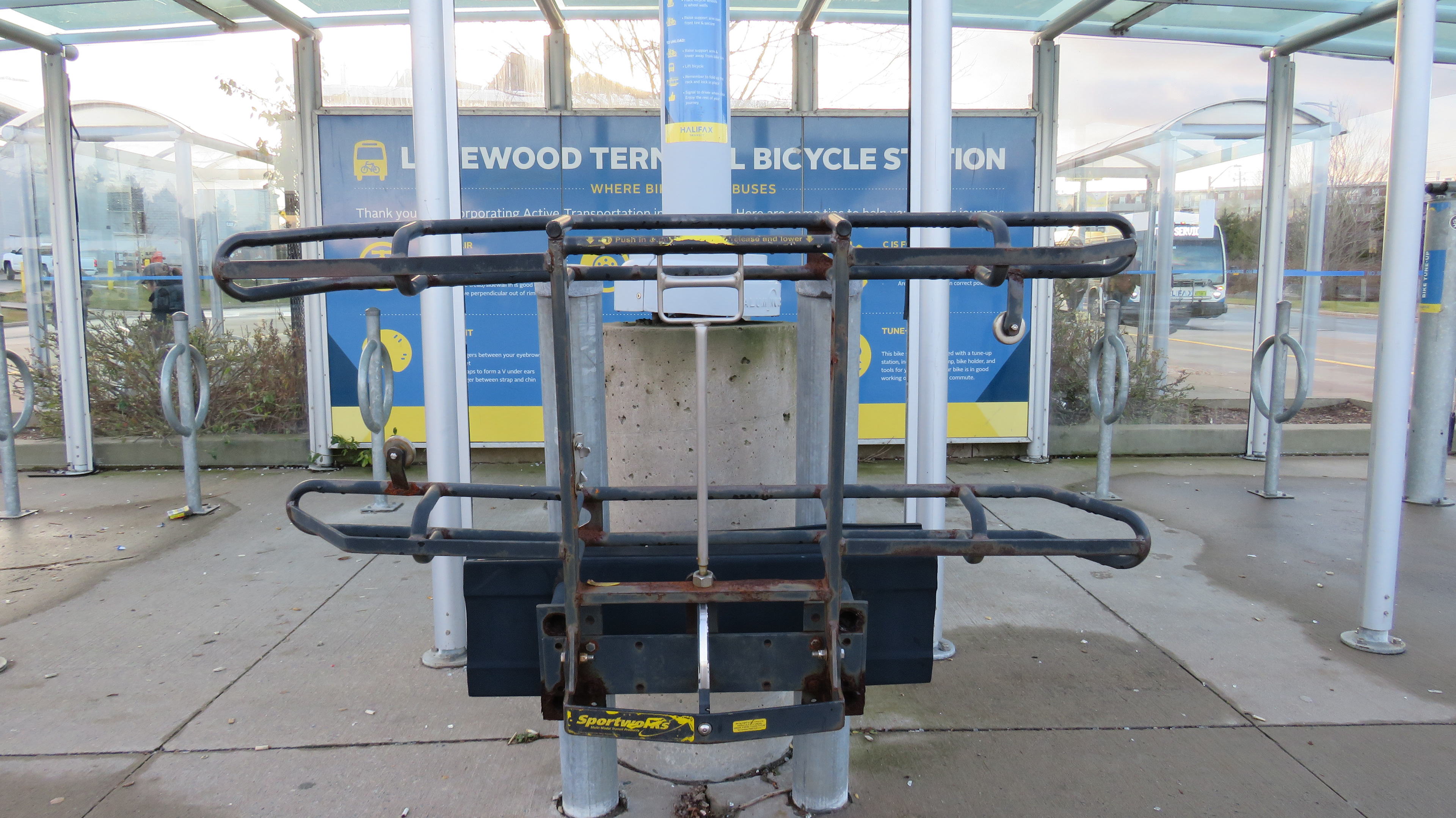
Halifax Transit is interested in having more people use their bus bike racks. This practice rack is installed at Lacewood terminal for people to test the racks before they have to board the bus. The pole behind it has basic instructions on how to use the bike rack demo station. Behind the bike rack demo is a sign educating people on basic safety checks and tools for cyclists to do quick bike repairs. In comparison to the safety sign behind it, the Bike rack instructions are easy to miss.
Research: Identifying Challenges
During the first half of the project, we were tasked to research our chosen topic by collecting data, exploring existing solutions, monitoring current events, analyzing user experience, and collaborating with experts. Originally, I was exploring public transportation; in my mind not enough people cared about cycling in Halifax because I never see any cyclists. It wasn't until the research took shape that I realized concerns for safety were deterring cyclists, not the lack of interest. I discovered many products and services geared towards cyclist safety, but the solutions that had a significant impact on city ridership was construction of bike lanes. Bike lanes that provided barriers between cyclists and oncoming traffic, and bike lane networks where each bike lane was connected to each other resulted a higher number of cyclists within a year for cities like Copenhagen, Denmark; Seville, Spain; and Montreal, Canada. Halifax was on track to building its own bike lane network before the project was postponed this past summer.
The Challenge became this: how can I use design to link these gaps in our existing bike lane network, ensuring cyclists were safe during their entire ride? I sat down to chat with Ben Hammer: an urban planner that has been working towards better bike lane networks across the province. During our conversation, Ben brought up the bike racks, and his recent project at Bike Again installing a bike rack demo station. We discussed all the ways people could use the bus as a link between the gaps in the current bike lane network. Public transit can also serve as a back up plan to get home, or an opportunity for cyclists to get out to any of the provincial parks on the edge of the city. I decided I wanted to redesign the interaction with these bike racks so that more cyclists are encouraged to try it.
The main challenge of this project isn’t explaining how the bike racks work; I found the process simple once I understood how the bikes were held in place, and there are a number of tutorial videos created by municipal governments and local cycling organizations. The problem was the fear. I engaged with online forums and spoke with students and professors about their perceptions of the bike racks. Many of the experiences were the same: they were fearful of standing in front of a bus, taking up people's time while they tried to figure out a complex contraption they had no prior experience with. One person on reddit described how they first "approached the bike rack as they would a feral animal" before realizing the rack itself was rather straight forward to use. A fellow classmate expressed anxiety about standing in front of the bus in case it starts to move while you're still loading your bike. A professor described their only experience using the bike racks for the first time in the dark, and being unable to see where the bike slots into the rack. My Link informational displays will have to address these fears as well as teach people how to use the racks. My plan is to take this nervous-anxious energy and turn it into nervous-excited energy by framing the whole experience as a fun adventure.
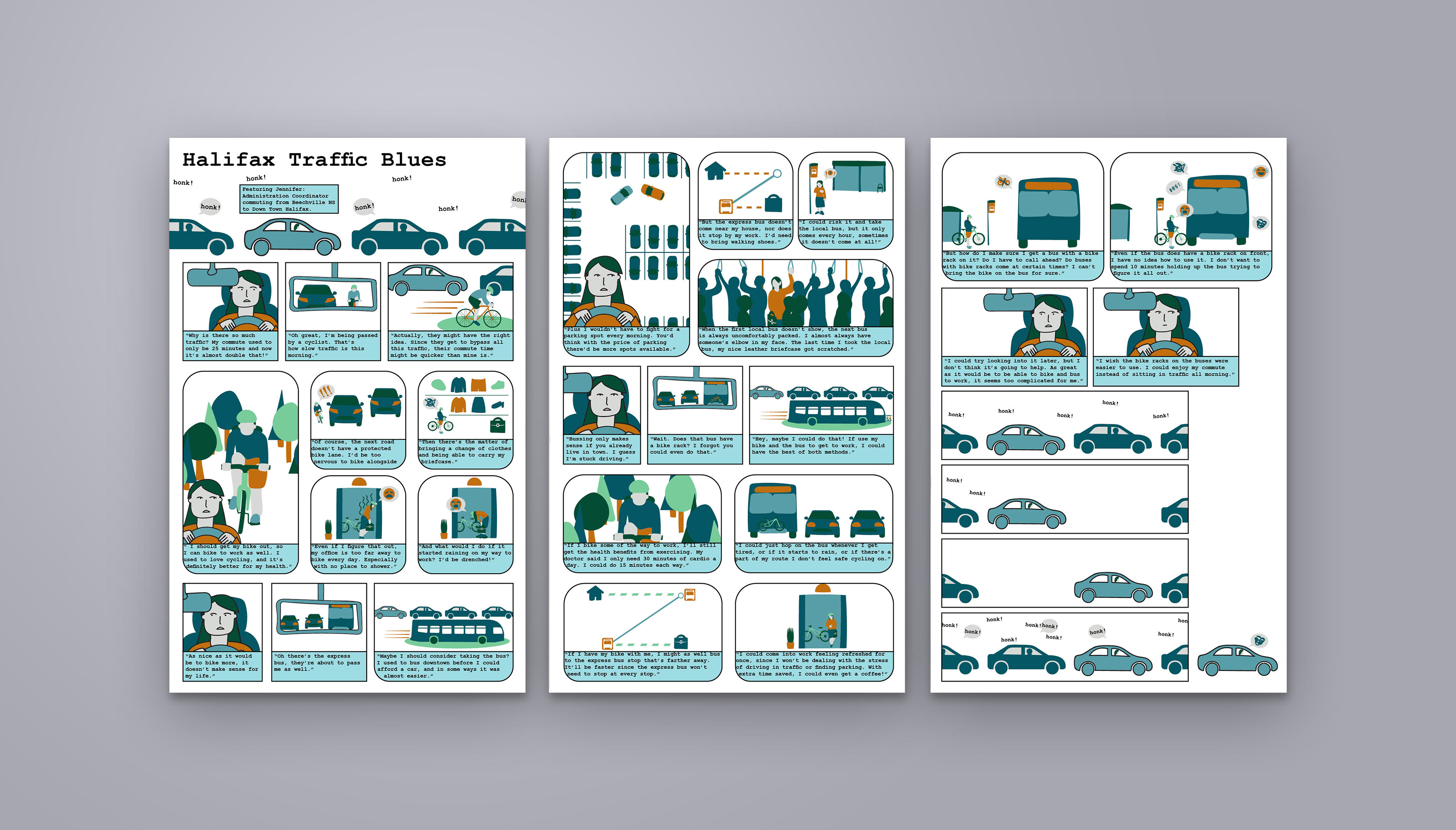
I created a story board to illustrate the common perceptions I gathered about the bus bike racks. This story follows our character "Jennifer" as she commutes to work. While she is stuck in traffic, she reflects on how much she dislikes driving in Halifax traffic, but can't seem to find an alternative that meets her needs. The express bus doesn't stop close to her house, and she lives too far away to commute by bike. Eventually she sees a bus carrying a bike on the front, and considers how she can combine the two methods. Unfortunately, her anxieties and lack of familiarity deter her from committing to her plan, and she is stuck driving to work.
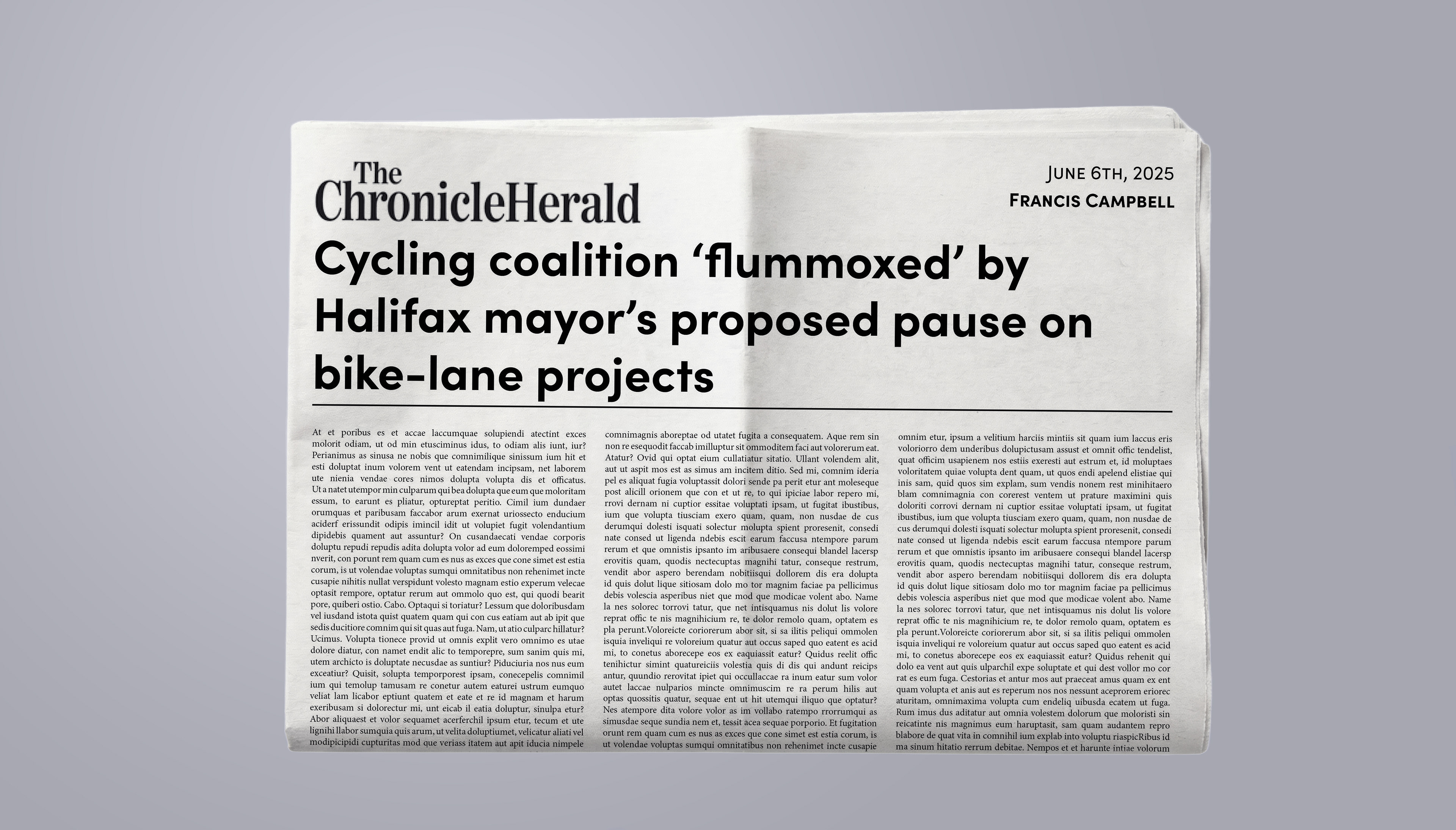
As part of the research phase of this project, I monitored local headlines around cycling during 2025. The following pattern emerged: every time an article was published about a cyclist fatality or the development of the All Ages and Abilities bike lane network was further delayed, several articles followed calling for better cycling infrastructure. The example abouve "Cycling coalition 'flummoxed' by Halifax mayor's proposed pause on bike lane projects" comes after Mayor Andy Filmore paused the All Ages and Abilities project due to budget concerns.
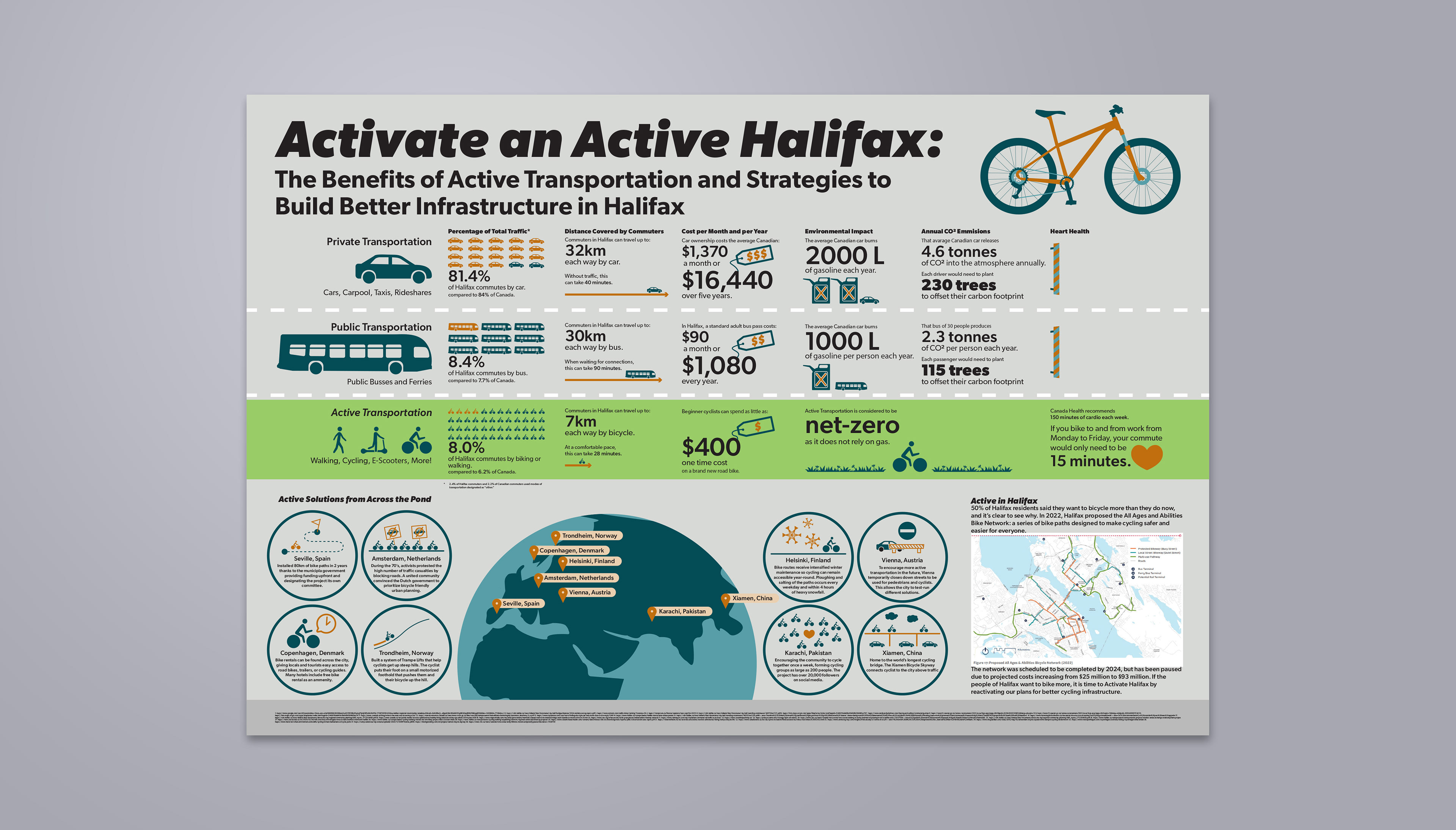
This infographic explored the benefits of cycling over other modes of transportation, highlights how other cities have prioritized cycling, and summarizes Halifax's own All Ages and Abilities project. It was during this phase in the research that I pivoted from public transportation issues to active transportation issues.
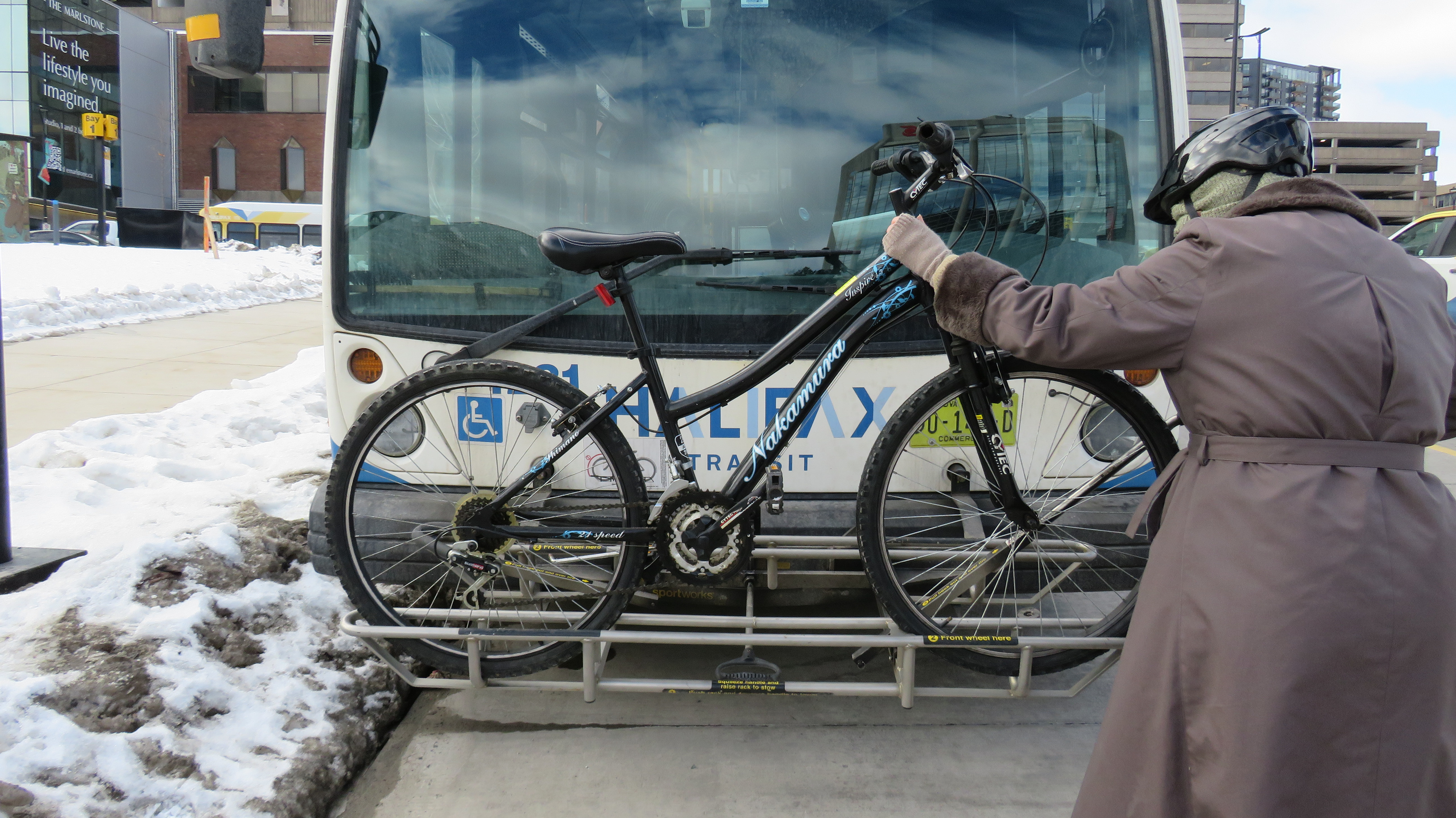
This is a reenactment of my first experience with the bike racks. I first used the bike racks before the start of the new year when I purchased a bike off of facebook marketplace out in Timberlea. Even though I had seen how the bike racks worked at Lacewood, I was still anxious for my first time on a real bus. The cold served as an extra barrier as my hands were numb. The experience had me wishing I had a cheat sheet I could look at while I waited for the bus.
Watch the full research talk here. I go in depth about why I chose to address cycling in Halifax and explain the different methods I used to organize information. Video length is 12:36.
Brochure: Hierarchy of Information
Designing a large information display was a big project to take on (pun intended). as a starting point, I decided to use my familiarity with graphic design to mock up an informative brochure. The creation of the brochure helped me to define the informative display’s visual identity and tone of voice, as well as clarify instructions and misconceptions about the bike racks themselves. To replace a cyclist's nervous-anxious energy with nervous-excited energy I first give them a list of fun scenarios in which you can use Halifax Transit to supplement your "cycling adventure". Examples include "biking past a grocery store, deciding you want pizza, and bussing home with ingredients for pizza" or "running into a friend while cycling and bussing to your next destination together." I assume most people will use Halifax transit to support their daily commute or their mundane, non-pizza-related errands, but by providing cyclists with fun examples I aim to open up the possibilities and distract them from their initial worries. Next, I address these worries of their in a list of frequently asked questions. My goals is to show that these questions are frequently asked, and they should feel reassured that others have the same worries. "Does every bus have a bike rack?" All of them. "Do I have a set time limit to load my bike?" No, take as long as you need. "How do I know my bike won't fall off?" That was one off my own worries that turned out to be a common concern. The bike hook is spring loaded to hold your bike in place. By addressing common questions before explaining how the bike racks work, I aim to empower cyclists so they feel capable of attempting the bike racks. Only when cyclists are feeling excited and empowered do I show them the three easy steps to using the bike racks. The instructions in the brochure are consistent with the instructions printed on the bike rack, but with the brochure I have extra space to clarify some of the instructions. For example, it's not clear that the handle locks the rack into position and that lifting the handle unlocks the bike rack to be lowered. I have also drawn icons to accompany the instructions and help illustrate where to look. The icon for step three illustrates where the hook should sit against your bike. I also color-coded the instructions to represent what you are interacting with at each step: yellow and blue for when you are interacting with the bike rack, and green for when you are interacting with your bike.
During my initial test of the bus bike racks, I found myself wishing I had a "cheat sheet" to refresh myself while I waited for the bus, instead of stewing in my own nerves. I plan to develop this brochure further to meet this need for other cyclists. I intend for these brochures to be distributed in community centres, public libraries, tourism booths, cycling stores, inside bus terminals, or anywhere an information display can't be installed. Click on each photo to see details or read more information.
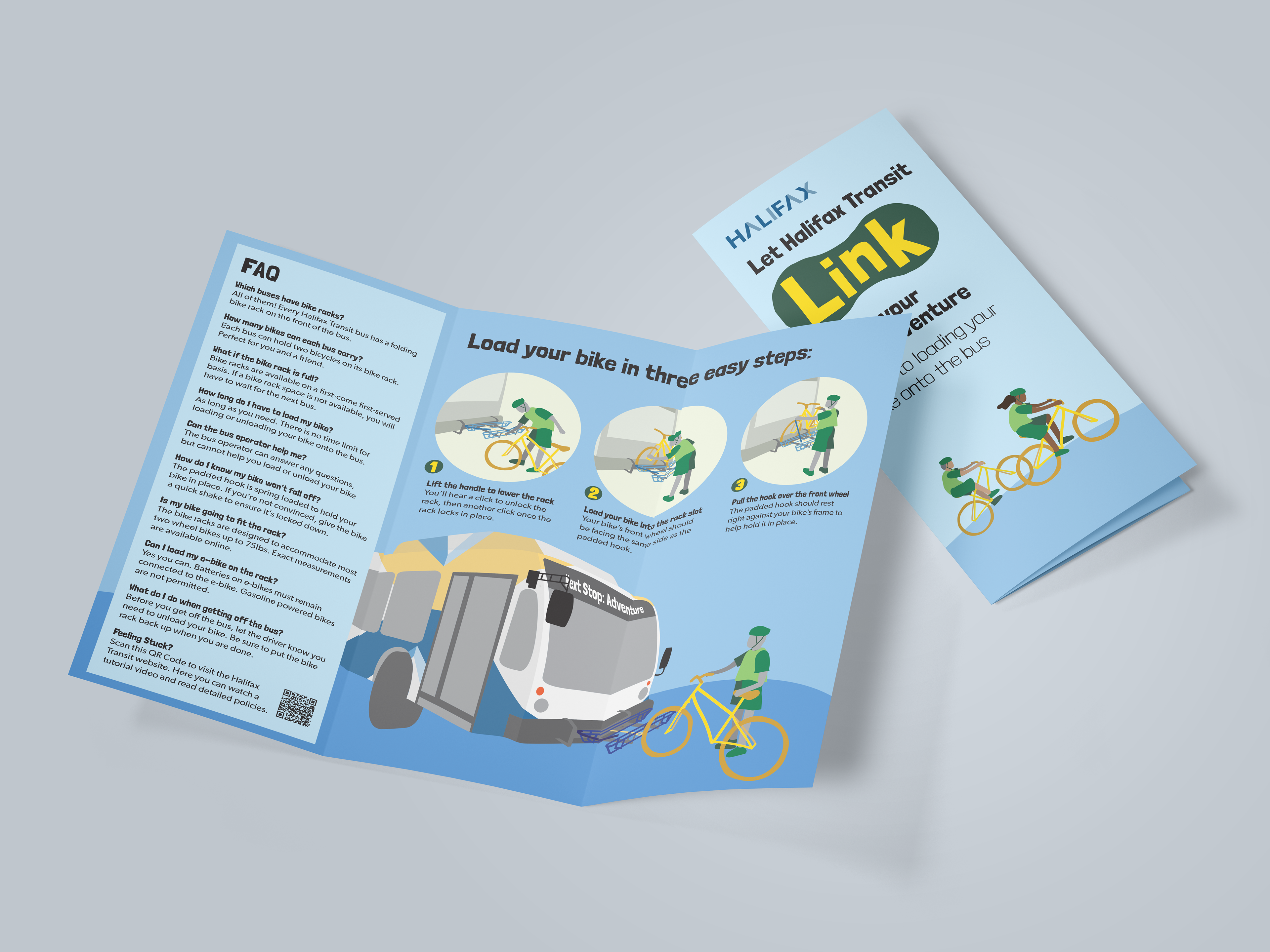
Mock up photo of the final brochure
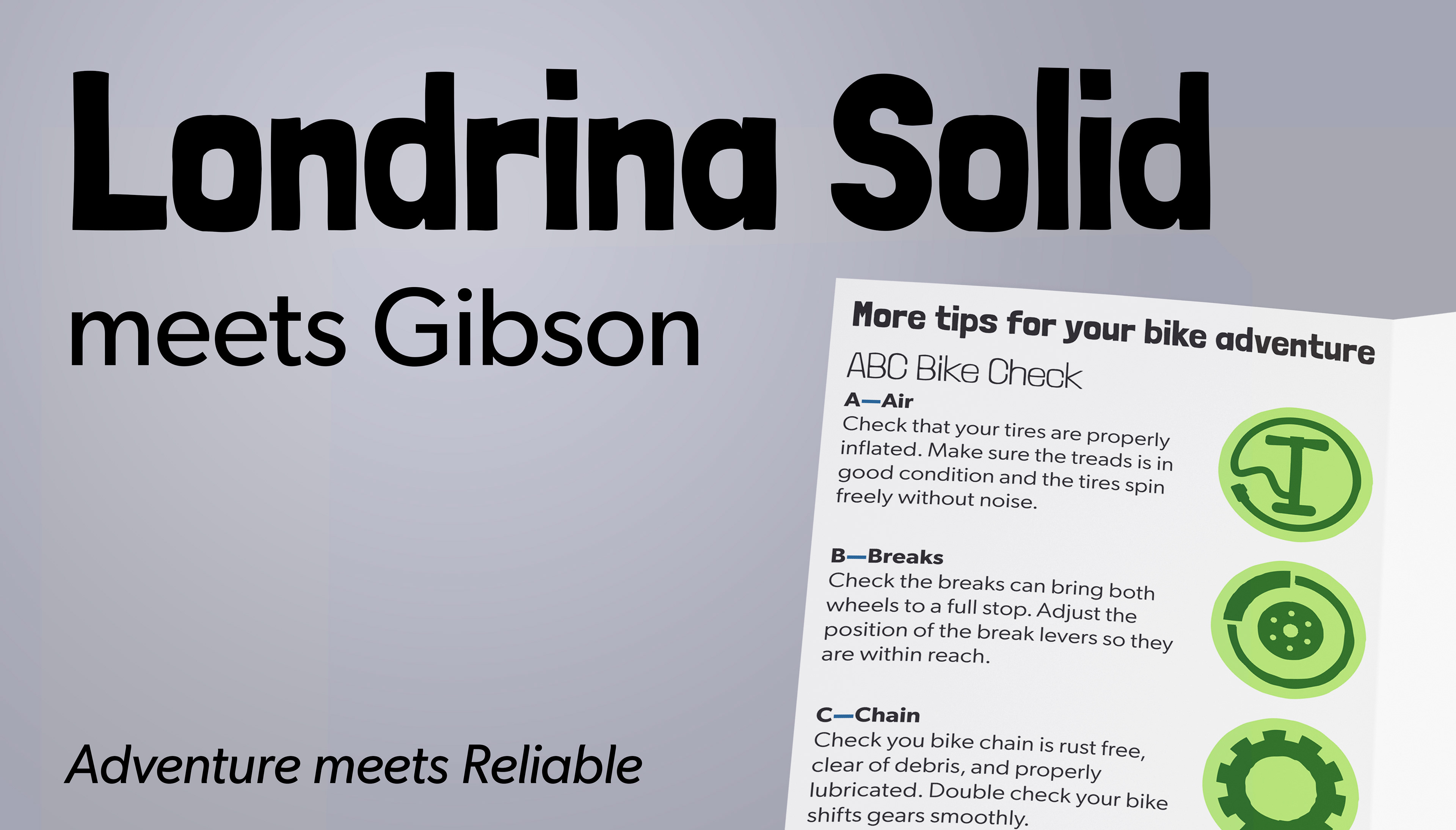
I chose the typefaces Londrina Solid and Gibson for my headlines and body copy respectively. I chose Londrina for it's rugged and adventurous appearance. Londrina is available in perpetuity on Google Fonts, meaning it will be forever available to serve as the face of the Link Informational Displays. I selected Gibson as the body typeface for its legibility, simplicity, and similar x-height to Londrina. Gibson is currently available on Adobe fonts, meaning it's free for commercial use while the licence is active.
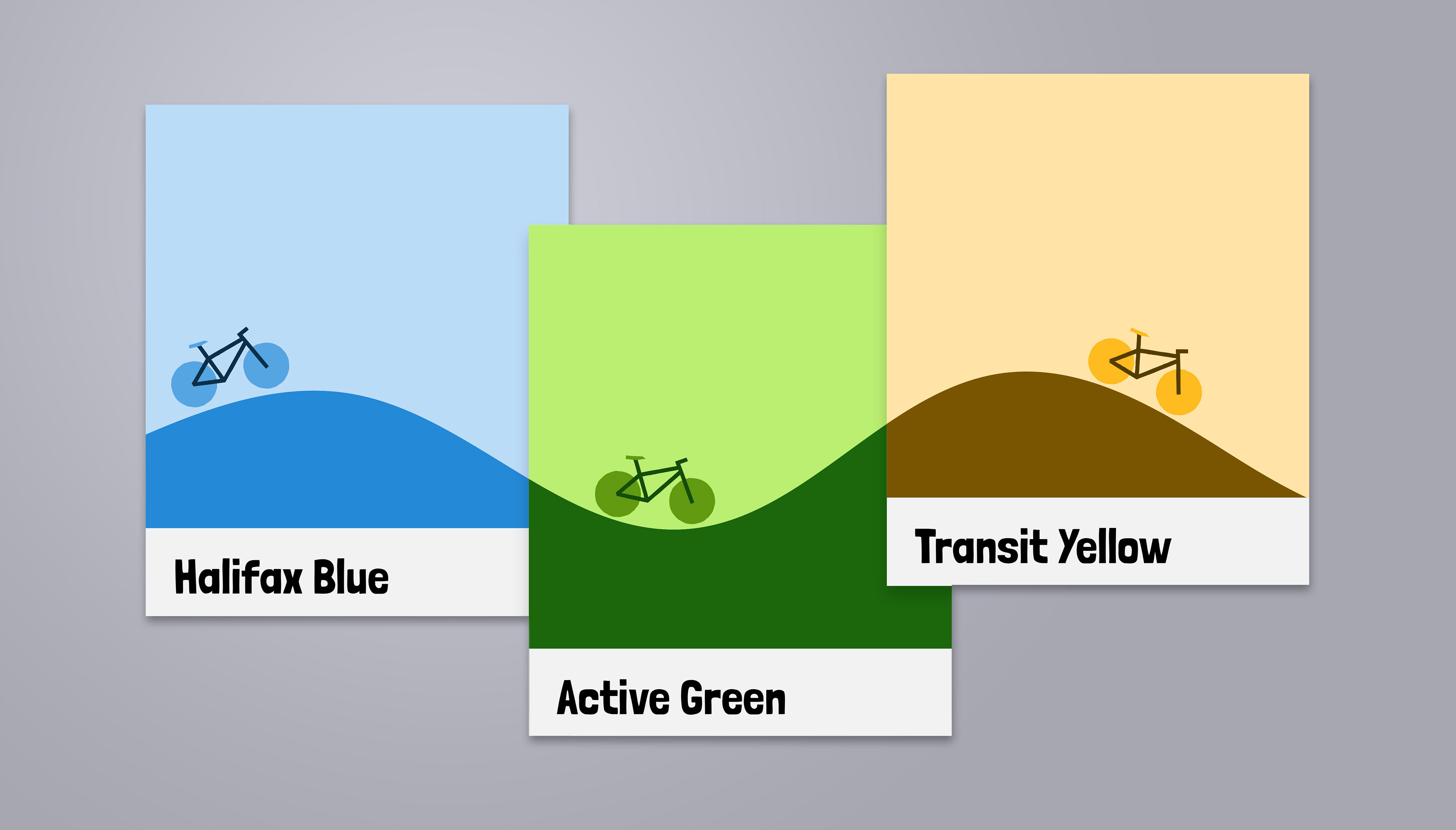
I based the color palette for this project on colors already associated with active and public transportation in Halifax. The blue and yellow are the same hues that Halifax Transit uses in its own branding, and the green is based off the color of the existing bike lanes. Conveniently, these three colors for a very nice analogous palette. To further link these three colors together, I add a yellow tint to the lighter green colors and a blue tint to the darker green colors.
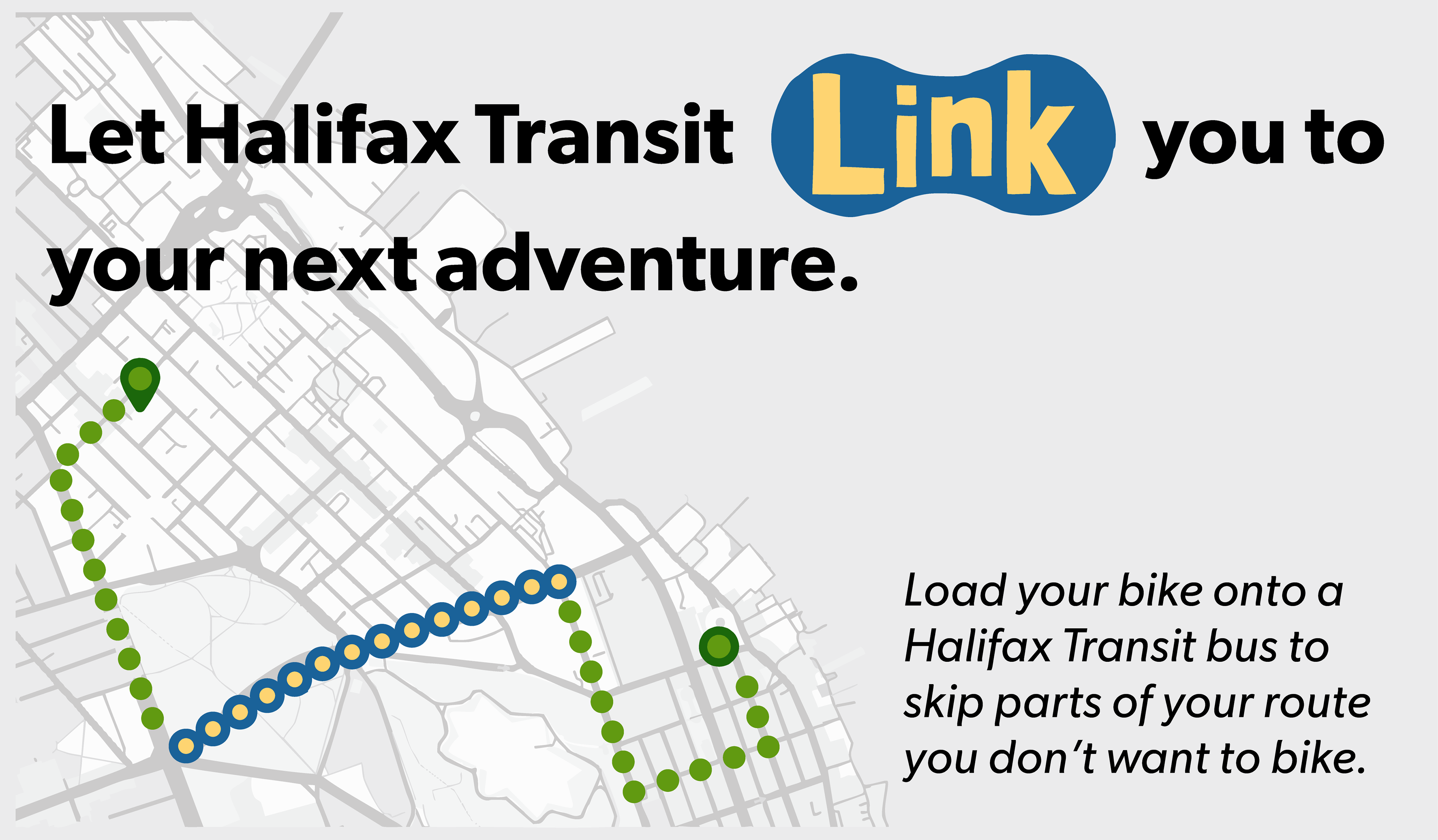
The Link motif shows up frequently throughout this projects language and visuals. Where the goal of using Halifax Transit is to have a complete path from one place to another, I use the imagery of bike chain links to "link" your route together. The illustration above shows the logo, the language, and a map motif in use together.
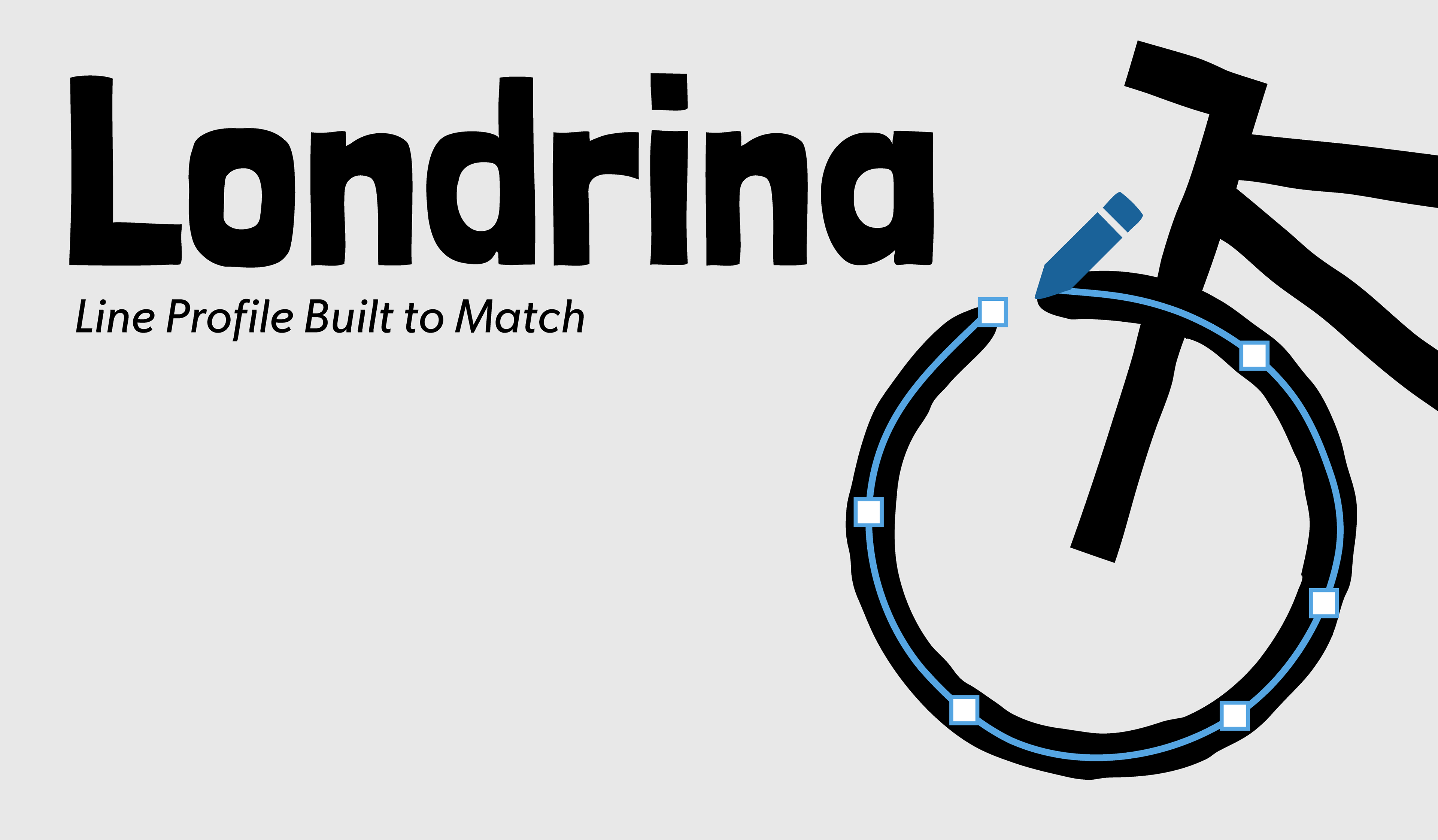
I wanted my illustrations to have the same rugged line profile as my chosen typeface, Londrina. Using Adobe Illustrator, I created a line profile brush to mimic the same rugged texture across all of my line work.
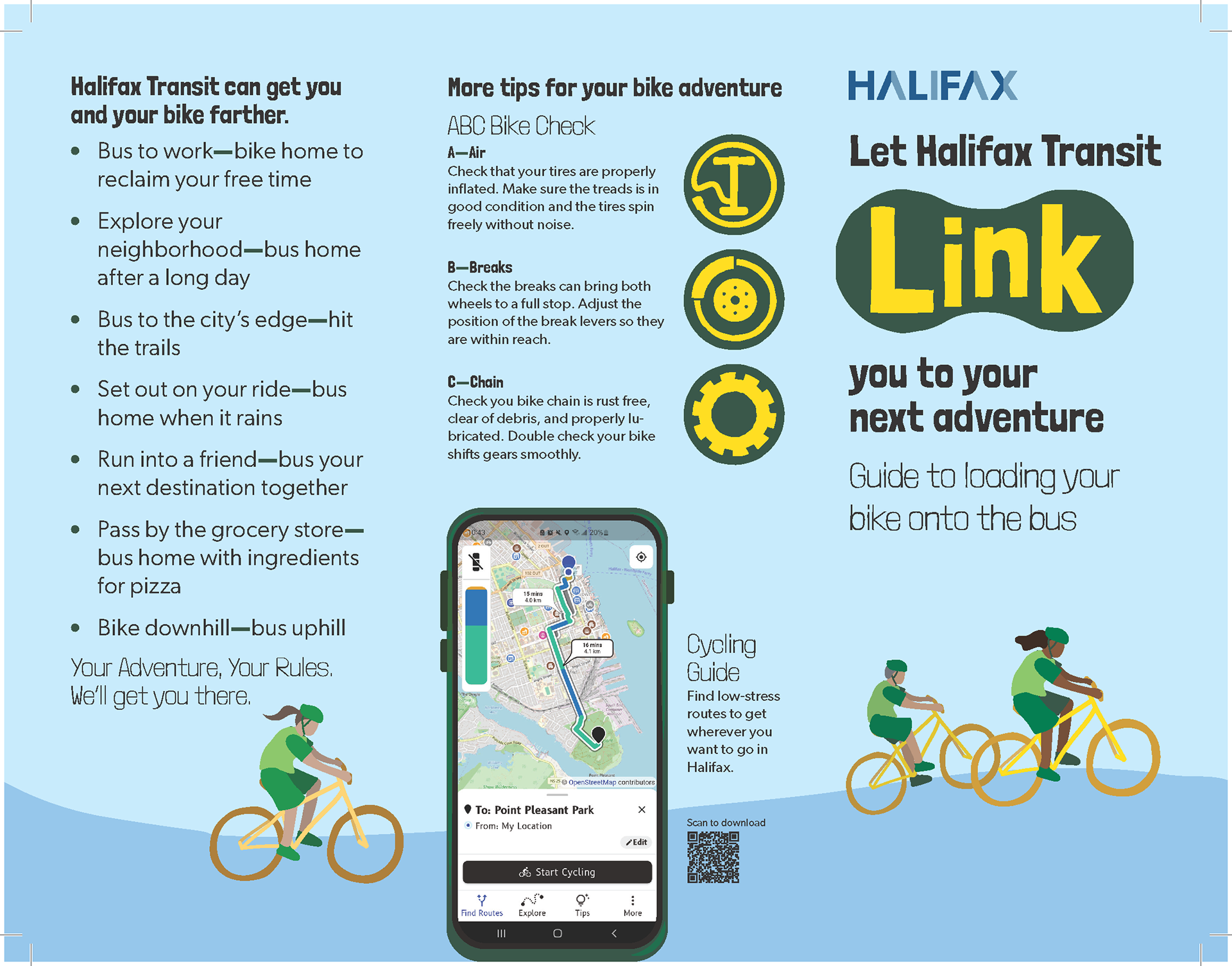
Outside view of the brochure. When folded, the cycling tips will appear on the back cover and the list of example scenarios will appear in the inside flap. For cycling tips, I explain a popular mnemonic device for basic bike repair and direct cyclists to an app that assess a cycling route's incline difficulty and traffic difficulty. The map motif leads off the cover into the inside of the brochure.
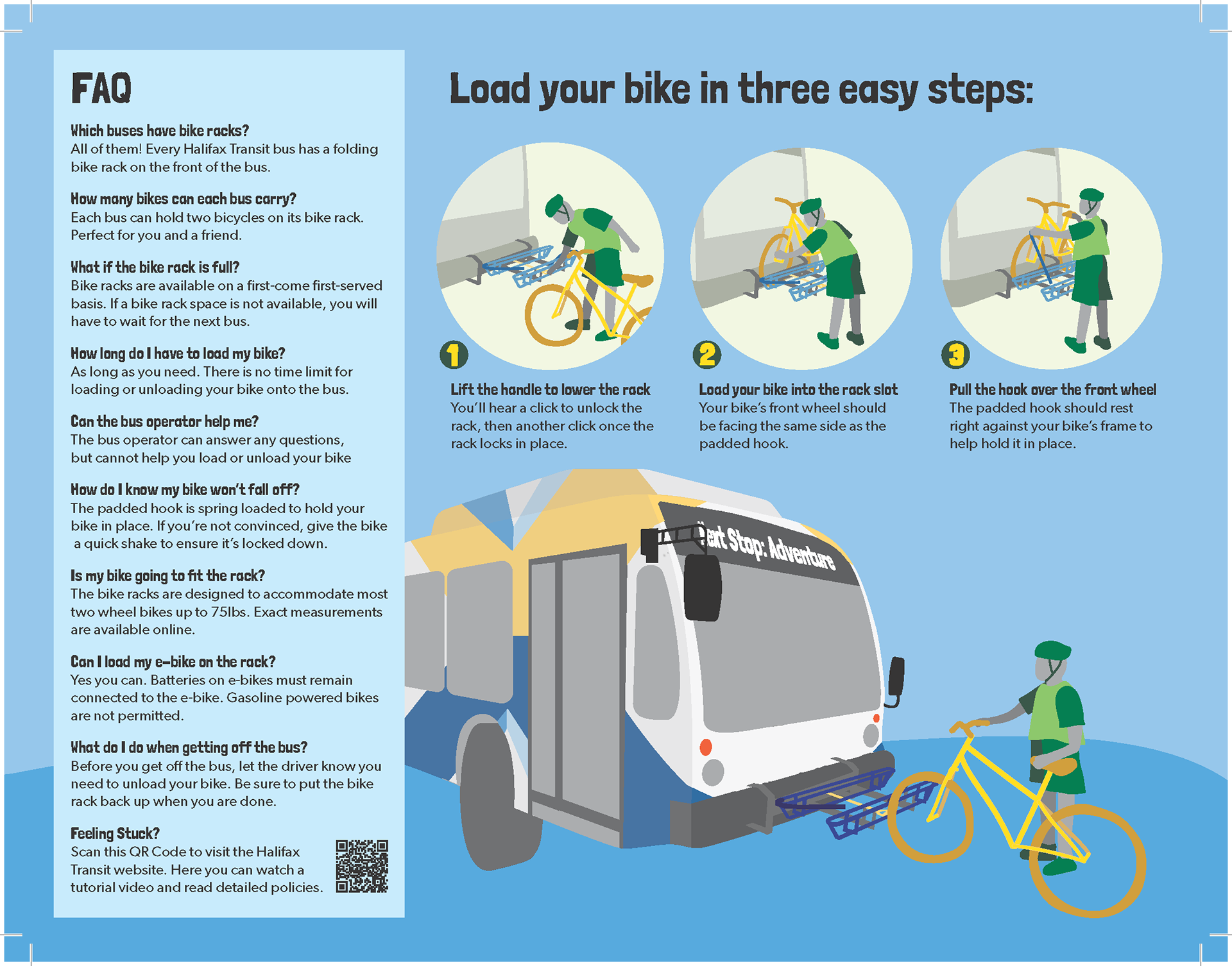
Inside view of the brochure. As mentioned previously, this section addresses frequently asked questions and easy steps for using the racks. The map motif leads across and down to the bottom right, asking cyclists "where will you go next?" This isn included as a fun easter egg for attentive readers, to add an additional element of fun to the information.
Display: Development and Execution
The brochure design served to establish the brand identity and hierarchy of information, and will be useful as supplementary materials; however, the main goal of the Link Informational Displays is to alleviate fear with experience. The experience of trying the bike rack is essential to the anxious-to-excited journey, and that experience is hard to replicate on paper. One of the biggest fears I encountered that can't be addressed with a brochure is act of standing in front of a bus. Having a bus loom over you is a daunting part of the bike rack experience that I want to get cyclists accustomed to at the start, so I have designed the signage to look like a bus. To scale. I quickly learned that designing a bus-sized layout has different challenges than designing a report for print or designing a webpage would. Working to scale has been challenging, but necessary to how big my type needs to be and where to place it so that it's comfortable to read. Thankfully, the Canadian Museum of Human Rights in Winnipeg, Manitoba has published the "Inclusive and Accessible Design Guidelines" for use in exhibit design. These guidelines help me shape the "zones" on my signage where I mapped out different pieces of information. The current layout of the informational displays is pictured below, along with considerations for intended use. Again, click on each image to see more.
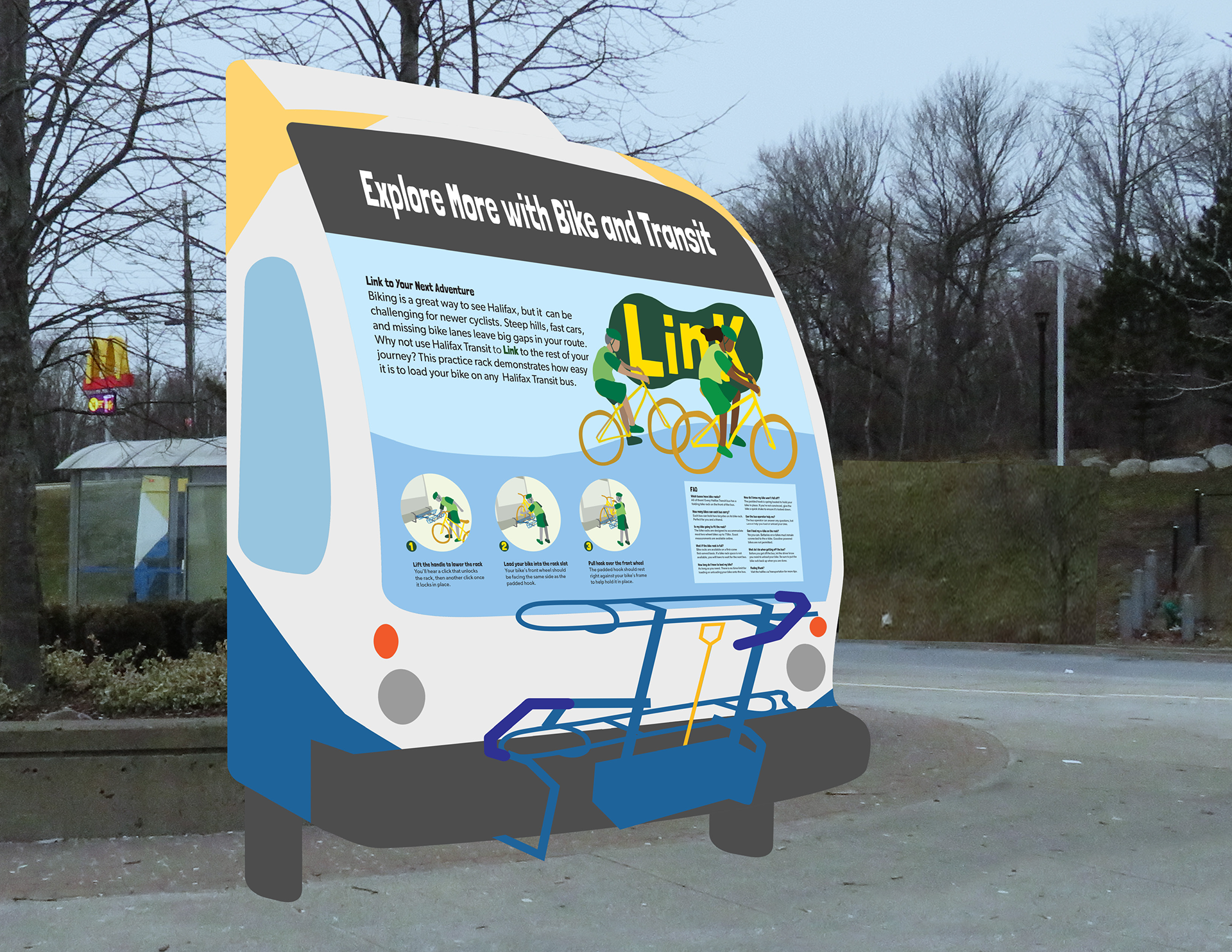
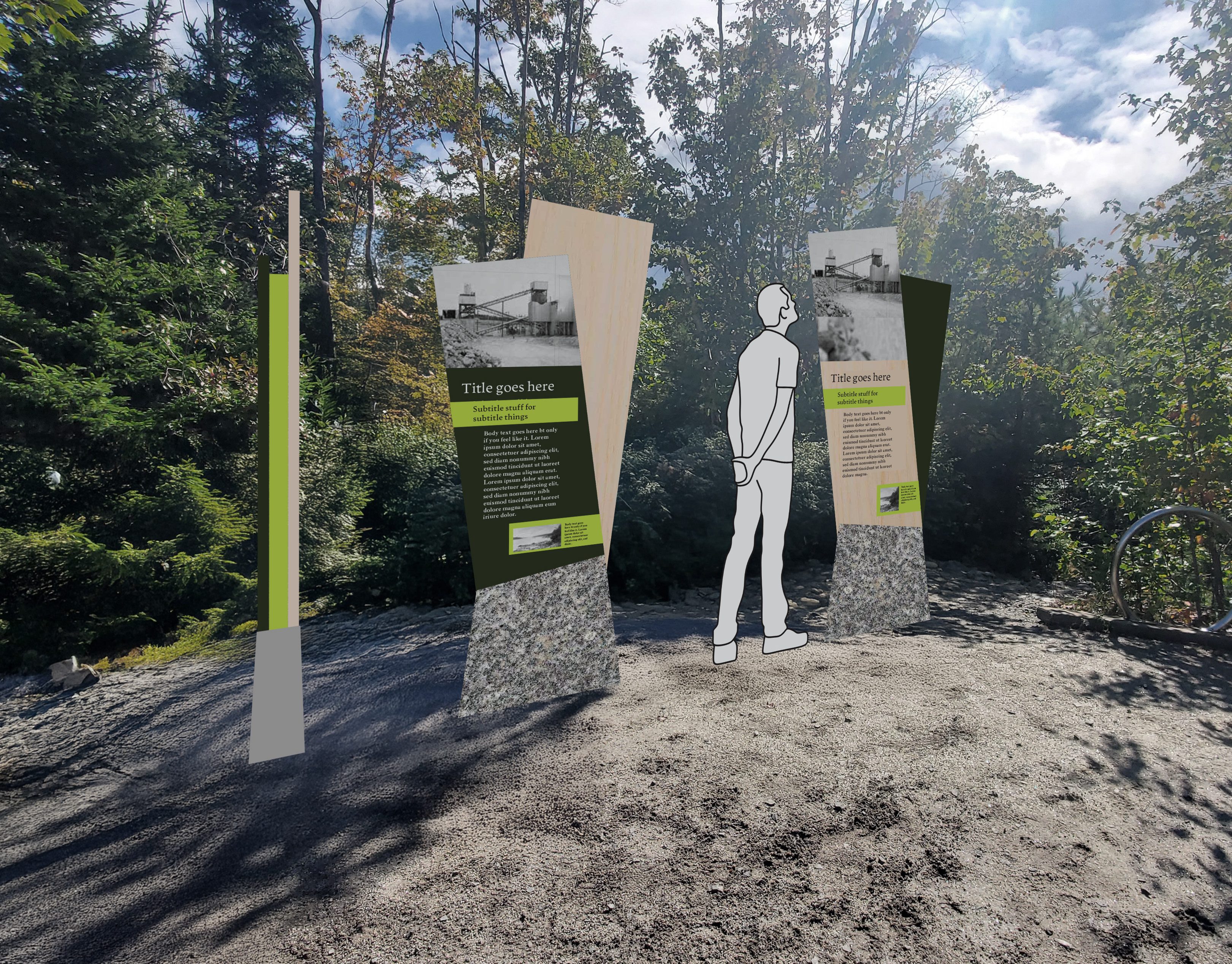
The current Link Information Display as it may look installed at a park. I intend for these informational displays to be installed at bus terminals, parks, and outdoor community spaces. The back side of the signage can be used for bike repair tips similar to the signage at Lacewood terminal, or it can have a new function like displaying a map of bike lanes in Halifax, or as a notice boards to serve as "inspiration fro your next adventure". The permanent displays would be installed into the ground with concrete posts. A version of the permanent display can be adapted for retail spaces that sell bikes, to promote the use of bikes and increase sales.
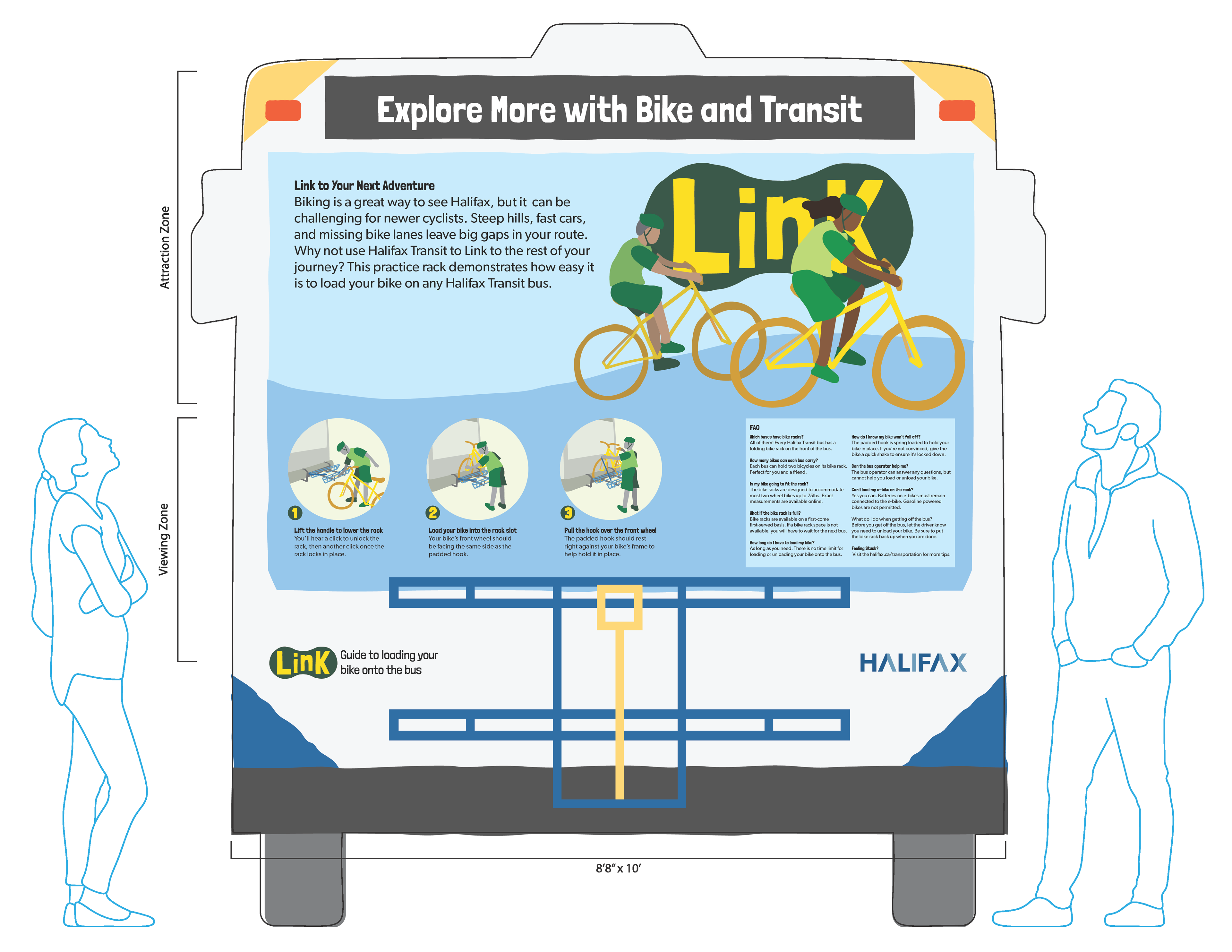
Front facing design of the Link Informational Displays. I have prioritized information to the left side of the bus, where passengers would be boarding from the side walk in a real scenario. In this example, bike rack and the handle have been painted to match the color-coded instructions.
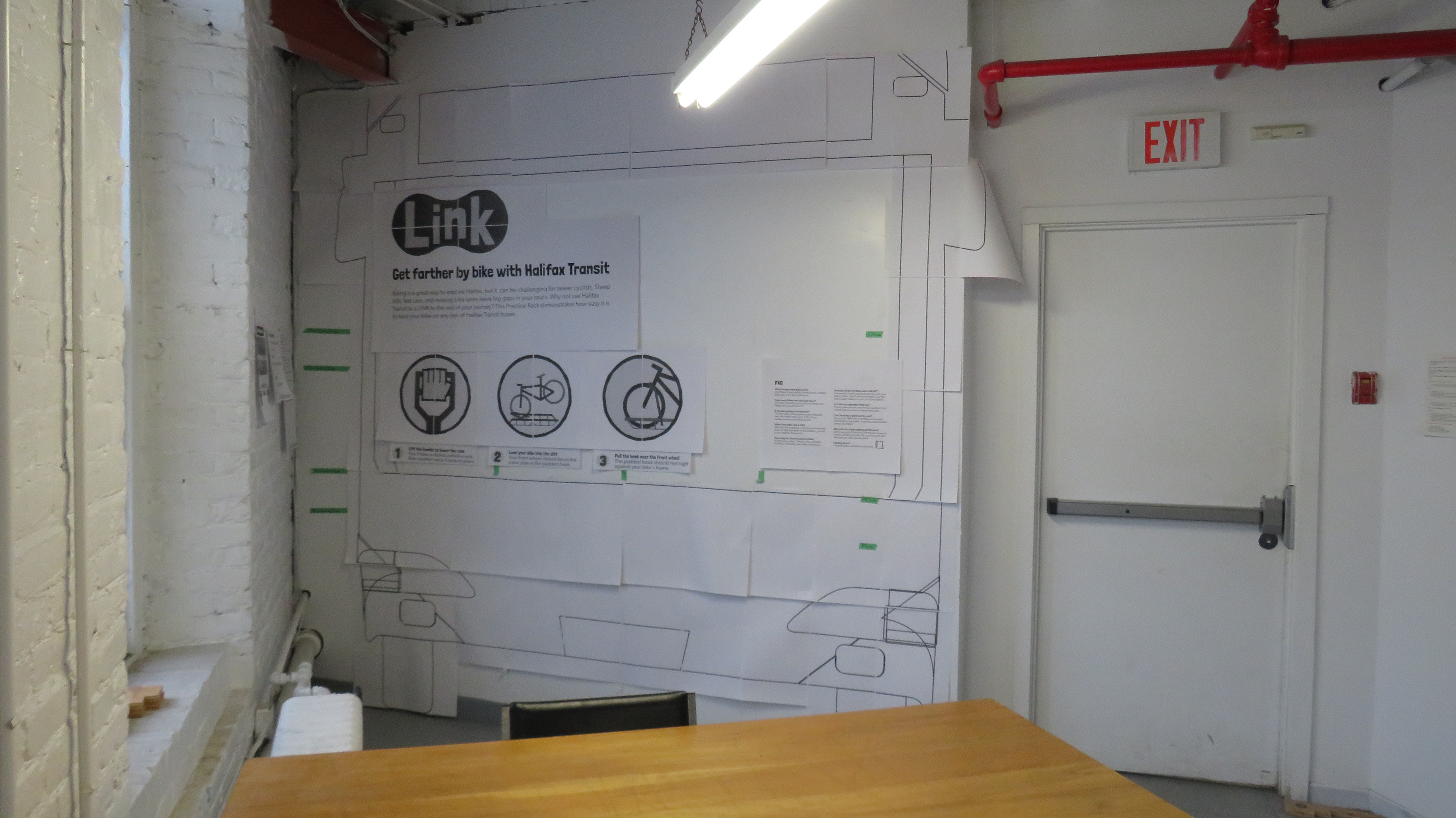
Basic mock-up of the informational display to scale. the ceilings were slightly too small to display the full height of the signage, and I have limited the layout to where I can comfortably reach. The green tape marks different zones on my signage to help me navigate as I test different layouts. This bus was made by printing parts of the bus on sheets of paper and piecing them together like an oversized puzzle. In future projects, I would like to try a less time consuming, more accurate approach.
Impact
The Link Informational Display will not fix cycling in Halifax. I knew going into this project that the safety risks, urban planning logistics, and collective attitude towards cycling cannot all be solved in one fell swoop. The idea may inspire a handful of people to start cycling more; it will at least inspire me, since I now own a bike thanks to this project. That is not the impact I envision for this project. Instead, I see this project acting as a starting point that will grow exponentially. When this project unveils in May, it will be warm enough that cycling and spending time outside will be on people's minds. People will be talking about this ambitious student project and share their own take on the issue. My project may inspire another project, and then another one after that. Different ideas will inspire different people to give cycling ago, even if they try it once. Enough people will keep cycling, increasing the total number of cyclists and decreasing the number of cars on the road. The decrease in cars will ease traffic congestion, which has been ranked the 3rd worst in the country for two years straight, and make it safer for even more cyclists to make the switch. The goal is to inspire enough new cyclists that the city of Halifax understands the value of continuing to build the All Ages and Abilities bike lane network they conceived with the Integrated Mobility Report. The existence of such a report, and the existing bike rack demo stations is proof that Halifax is aligned with this goals despite concerns for budget. In fact, the Integrated Mobility Report was created with the goal of having at least 30% of trips to be made by transit or active transportation before 2031. If Link Informational Displays can remove safety and accessibility barriers for some cyclists and inspire fresh ideas for others, my project can positively impact progress towards this goal.

Conclusion
The Link Informational Displays, and the Design Degree project as a whole, have been a test of everything I have learned in my time at NSCAD and everything I still have yet to figure out. Though the project will continue to be developed until April, I am proud to share to work I have done so far. I am thankful for the opportunity to work on a large-scale environment graphic design project while I still have the guidance and support of professors and fellow students. My completed project, and the completed projects of my fellow graduating classmates, will be unveiled at the NSCAD Design Grad Show this May.